
Tereza Kozinc, Simon Chang, Stojan Kerbler and Nik Erik Neubauer: As reality disintegrates, at least these dignified pictures
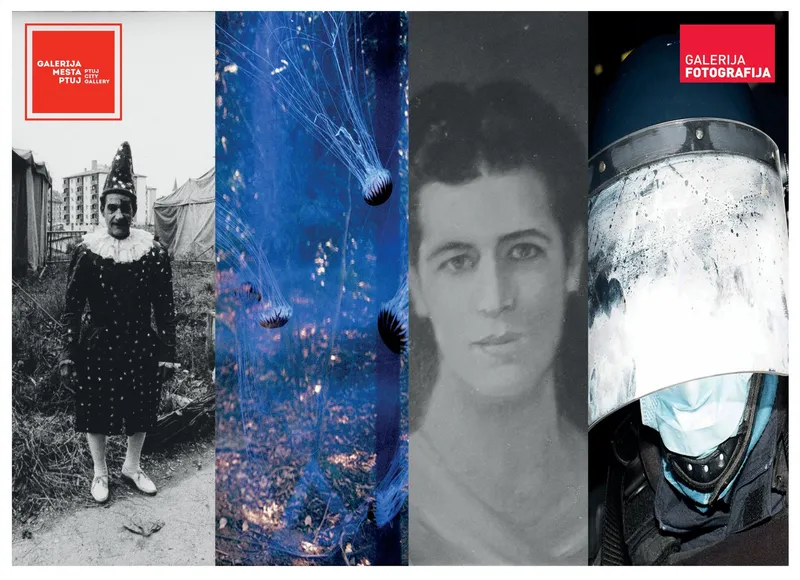
The group exhibition at Ptuj City Gallery presents works by four Slovenian documentary photographers exploring personal, social and cultural realities through different artistic approaches. The exhibited works invite reflection on belonging, identity, community and memory, with the presented photographic series oscillating between intimacy and collectivity, as well as the past and the present. Despite the diversity of the photographic approaches of Simon Chang, Tereza Kozinc, Stojan Kerbler and Nik Erik Neubauer, many parallels can be observed between them, stemming from the photographers’ sensitivity and receptiveness towards their subjects and their in-depth, long-term exploration of selected topics.
Simon Chang (1978), originally from Taiwan and based in Europe since 2003, focuses his work on the stories of marginalised communities and people whose voices are rarely heard. Known for his long-term photographic projects spanning several years, he connects with his subjects on a personal level, establishing a deep mutual trust and creating space for exchange. The exhibition presents two of Chang’s projects, 1/2 Home and Shepherds and the Slaughterhouse. The first is dedicated to the photographer’s division between his native Taiwan and Slovenia, where he lives with his family. Symbolically, the two places are connected with postcards he sent to his loved ones from Europe. As Chang puts it: "Taiwan has become something in between: not fully here, not fully gone. A ‘1/2 Hometown’. I miss it in unexpected ways, especially when I see the sea. That’s when I feel homesick. Not exactly for my hometown, but more for the feeling. For a home that no longer exists." In his second project, Shepherds and Slaughterhouse, he addresses the often hidden but pressing issues of mental disorders in regions of former conflict. His series was filmed in Kurdistan, an autonomous region stretching across northern Iraq, Syria, Turkey and Iran, which has been subjected to violence by Islamic radical groups since 2014. Chang presents the story of (not) caring for the most vulnerable in two places that are hidden from public view but are incredibly similar in their relationship to the Other: a psychiatric hospital in Erbil and a slaughterhouse in the Semel Mountains.
Tereza Kozinc (1985) creates at the intersection of diary and documentary photography, joining minimalist reality and impulsive surrealism, with the central theme being the search of home in both an emotional and geographical sense. In her latest project, entitled How to Photograph the Wind, she intertwines historical facts and family legends, seeking reflections of her own everyday realness in the stories of her ancestors. In her exploration of family roots and relationships, she presents the pirates of Senj, who plundered Venetian ships on the wings of the bora wind in the 16th century and, after being defeated, were exiled to the area around Kostanjevica na Krki with the task of defending the area from the Orthodox Uskoks and cultivating the barren land. The multimedia presentation includes photographs of the artist’s grandmother’s native village in Dolenjska, audio recordings of the artist’s father and grandmother’s sister, photographs of the daily rituals of the artist-mother and her son, and audio documentation and photographs of the landscape around Senj, which has been characterised by the same basic elements – the bora wind, the sea and stone – throughout the centuries. The exhibited works are a tribute to the heritage of family history and, at the same time, the beginning of its continuation, which gives Tereza’s visual narrative a distinctly tactile quality of intergenerational depth.
Stojan Kerbler (1938), the first photographer to have received the Prešeren Award for lifetime achievements, has created an exceptional visual archive of the world, which is now only a memory. He narrowed his photographic work to the Haloze region, a rural area in Northeastern Slovenia, in which he sought not spectacle, but the tranquillity of closeness and genuine human connection. The exhibited photographs comprise two sets: intimate family scenes, both poignant and full of affection, and exceptional portraits of the people of Haloze, which stand out for their striking square format, immediately drawing the viewer in and bringing them face to face with the subjects. The entire set of portraits is being presented to the public for the very first time at this exhibition, while some family-themed scenes have also never been displayed before. Whether it is the curious or melancholic gazes of children, the hands of mothers who nurture, feed, gather and harvest, or the faces of fathers, lined with wrinkles from hard work and worry, Kerbler’s black-and-white images reveal the strong bond of trust between the photographer and his subjects. As a local, he entered their homes and chatted with them in the street without distance or moralising. The children in his photographs are not symbols of poverty, but bearers of dignity, curiosity and hope; families are not portrayed as problematic social cases of deprivation, but as communities of warmth, strength and mutual connection. It is precisely in this respectful closeness, in his ability to reveal the ontological depth of human existence in everyday scenes, that Kerbler’s humanistic sensibility is evident, elevating his ethnographically valuable images to art.
In his documentary work with his characteristic authorial style, Nik Erik Neubauer (1994) is highly topical. The artist’s eye immediately recognises or anticipates extraordinary deviations from the ordinary and presents them in the direct, yet always relaxed and colourful spirit of street photography, whether documenting protests at home and abroad or everyday glimpses of urban life. The series Where’s the afters? documents a period of intense protests that took place in Ljubljana between 2020 and 2022, and is also presented in a book of the same name. This type of documentation is not merely a reportage or the artist’s interpretation of events, but rather translates the community spirit formed by the protesters into a collective narrative about the specificity of the events, actively contributing to the process of historicisation. The photographs from the series White Smoke, Brown Glare were taken during a residency in New York, USA, and depict the splendour and misery of life in a metropolis marked by social and cultural differences. In doing so, Neubauer is critical of the idea of the American dream, which promises success to anyone willing to work hard enough, as the deep divisions of class injustice clearly prevent easy (or any) upward mobility on the social ladder. He ignites hope for a brighter future with photographs of communities, families, friends, colleagues and activists, who, despite the individualistic atmosphere of late capitalism, establish and nurture mutual bonds – a rarity that remains even as the world around us disintegrates.
The title of the exhibition, As reality disintegrates, at least these dignified pictures remain, comes from Simon Chang’s book, Shepherds and Slaughterhouse. In it, the artist uses photographs and essays to record his experiences of Kurdistan and its inhabitants. The title story refers to the experience of a Kurdish wedding in a refugee camp, which never progressed beyond its intended temporary arrangement. During the celebration, the wedding guests took countless photographs of themselves and posted their smiling faces on social media, most likely in a simple desire to escape the harsh reality of everyday life at least for a moment and share with the world some cheerful, albeit fleeting, moments of "normality". As our world falls apart, photographs do not merely depict visually appealing motifs, but rather records of realities, testimonies of mutual bonds and moments of connection between the artist and their subject. The exhibited projects, whether they are long-term analogue projects of Simon Chang, Tereza Kozinc and Stojan Kerbler or contemporary digital colour photographs of Nik Erik Neubauer, reveal diverse methodologies and perspectives that understand documentary photography as an open, sensitive and reflective practice. Simon Chang and Tereza Kozinc approach their work in a distinctly personal way, exploring and recording their own life stories through their long-term projects. Stojan Kerbler, a master of analogue photography, has left his mark on the history of Slovenian photography with his iconic series shot in Haloze, where he humanistically documented rural life as we no longer know it. The work of Nik Erik Neubauer is characterised by careful observation of everyday rituals and documentation of current social contexts in the fast-paced urban environments. The common denominator of the exhibited works is not a single theme, but a polyphony of perspectives, each establishing and maintaining connections while recording the world in its own way – as it was and as we co-create it in the present moment.
The exhibition was created in collaboration with Galerija Fotografija.
Curated by Barbara Čeferin.
Exhibition text by Vida Jocif.


