
Olena Zubach: Near Monochrome


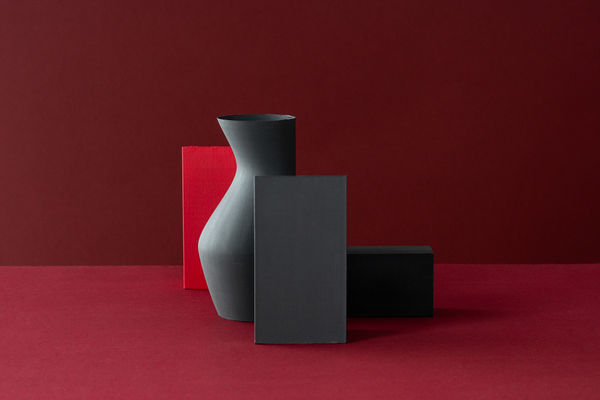

In her first exhibition at Galerija Fotografija entitled Near Monochrome, Olena Zubach presents a selection of her signature photographic still lifes. The artist’s tireless dedication to perfecting her motifs over recent years has undoubtedly paid off, as her refined artworks depicting seemingly everyday household objects reveal a harmony of shapes and colours of a simultaneously calming and inspiring nature.
At first glance, the works appear perfect. However, after only a few moments of observation, the viewer is prompted to ponder a multitude of questions. Although the motif and execution may be reminiscent of paintings, their placement in a photography gallery resolves the dilemma of whether they are perhaps just traditional paintings. A comparison with still lifes by the Italian master Giorgio Morandi is certainly justified, but Olena Zubach approaches the motif in a much bolder, fresher and more elegant manner. Yet doubt remains – are the objects in the photographs real? There is something uncanny, perhaps even supernatural about them. The vases, bottles, glasses and cups that the photographer arranges in various compositions are not ordinary kitchen utensils. With a few exceptions, all of them are printed with a 3D printer and then painted in various shades of chosen colour combinations. The source of the elusive feeling is linked exactly to the unusual nature of the objects in the photographs, which seem familiar at first glance but become increasingly mysterious and incomprehensible upon closer inspection. The viewer’s initial uncertainty stems from the very nature of the artworks. The artist’s genius guides and controls the creation of each work from start to finish – from the rough draft, design, printing and colouring of objects to the placement and composition of the work in combination with various studio backgrounds and settings. Everything is considered down to the last detail, with the geometric shapes and their proportions being perfectly harmonised. Perfection is not a matter of chance, but of the power of persistently following a specific idea. The artist’s creations also reveal marks left behind by the paintbrush she used to apply colour to the printed objects, the barely noticeable pattern of the gradual application of the 3D printer’s filament and the texture of the paper. It is the tiny deviations, discrepancies and irregularities that make the objects real, and the artist’s works convincing, tangible and authentic.
The choice of colours is not arbitrary either. Red and black were among the first to leave their mark in the history of art – the iconic cave paintings, left by our ancestors on stone walls using their own hands as stencils, feature red and black pigments of iron oxide and charcoal. Cinnabar was used for pottery painting in China as early as seven millennia BC, while European artistic creativity drew inspiration mainly from the slightly younger black- and red-figure pottery that developed in ancient Greece in the first millennium BC. Its characteristic colour shades depended on the amount of iron present in the clay. Unlike black, intense red was rarer and more difficult to obtain, and as a result, it was extremely valuable and for centuries only affordable to the social elite. Even today, red is a symbol of power, wealth, passion and vital energy, but also of suffering and danger. The meanings of the two colours partly overlap, as black, a non-color resulting from the absence of light, also represents authority and elegance, as well as mourning, uncertainty and calmness.
The above can all be sensed in the exhibited works. Strong and striking compositions in shades of red radiate confidence and vitality. With the use of more muted colour tones, passions subside, and clarity and prudence come to the fore. This is followed by dark compositions in shades of grey and black, which round off the narrative and have a calming and soothing effect. Still lifes create an illusion, an idea of beauty that we may try to pursue, but which always proves to be deceptive and unreal. The key is not to look for irregularities that are not there, but to recognise and accept them as part of reality. Using small unconcealed details, Olena Zubach creates timeless photographic still lifes characterised by a full-blooded presence, thoughtfulness and an essence of what it means to be human.
Vida Jocif

